JOSS
FOR SONOSURGERY
Innovation beyond convention

Safe, precise, minimally invasive.

Ultrasound × Orthopaedic Surgery
Sonosurgery: a new field in orthopaedic surgery.
Watch it evolve, with your own eyes.
An illustration of an ultrasound-guided procedure at the palmar wrist, with the needle tip and nerve followed on the monitor
News
What is sonosurgery

Sonosurgery is minimally invasive surgery in which ultrasound guidance is constitutive; it is also called ultrasound-guided orthopaedic surgery. Ultrasound is not an optional aid that happens to be useful; it is a requirement without which the procedure cannot be carried out. The type of instrument used forms no part of the definition.

Surgery has advanced together with its eyes. From the naked eye to the microscope, then to endoscopic surgery and to fluoroscopic surgery. Each became an established field in its own right, giving rise to dedicated instruments and dedicated techniques. Ultrasound-guided surgery is following the same path. Its capacity to visualise soft tissue in real time — a property that none of the other eyes possesses — makes procedures possible that were previously beyond reach.

Sonosurgery names a mode of surgery, not a device.

Sonosurgery applies musculoskeletal ultrasound to the operation itself. Centred on hand and upper limb surgery, it is performed as percutaneous or small-incision surgery without large skin incisions, aiming for treatment that is minimally invasive.

The Society currently covers twelve procedures, centred on hand surgery: trigger finger, carpal tunnel syndrome, de Quervain’s disease, wrist and tendon sheath ganglia, tennis elbow, Dupuytren’s contracture, Heberden’s node and others (Annexed Table to the Regulations on Hands-on Seminars).
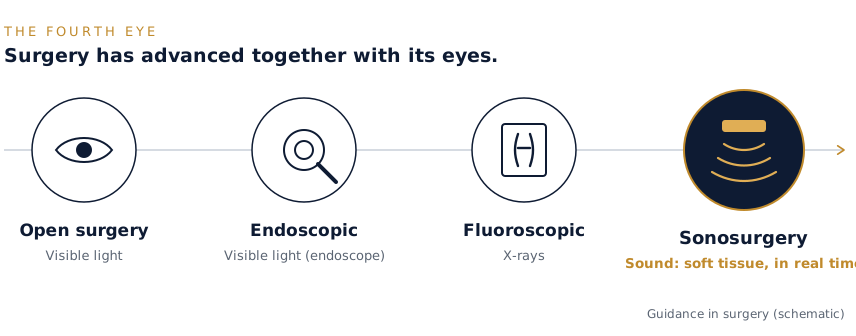
How the surgeon’s eye has evolved: open and endoscopic surgery use visible light, fluoroscopic surgery uses X-rays, and sonosurgery uses sound.
Why ultrasound
Open and endoscopic surgery use visible light; fluoroscopic surgery uses X-rays. Sonosurgery uses sound.
0 1
Resolution
Sub-millimetre resolution resolves tendon fibres and nerve fascicles.
0 2
Discrimination
Tendon, nerve, muscle and vessel each appear as a distinct pattern.
0 3
Penetration
Sound passes through blood. Bleeding does not take away the field of view.
0 4
Tomography
A tomogram, not a projection. Depth is apparent and any plane is available.
0 5
Real time
Gliding, excursion and blood flow. Instrument and target are followed together.
These properties presuppose the use of a high-frequency linear probe of 24 MHz or above (18 MHz at minimum). The Society regards the introduction of high-resolution ultrasound equipment as a requirement of membership.
What it offers patients
  • The field of view is not lost to bleeding
  • Vessels, nerves, ligaments and tendons are visualised precisely, without incision or exposure
  • Minimal invasiveness is not achieved at the cost of precision or safety
What it offers institutions
  • No costly equipment such as arthroscopy or fluoroscopy systems is required
  • General anaesthesia is not required
  • No assistant is required, since exposure is unnecessary
Our mission

Sonosurgery requires the introduction of high-resolution ultrasound equipment and demands both image interpretation and probe handling of the surgeon. The Society exists to establish sonosurgery within orthopaedics and to see it adopted more widely. At the same time, we regard it as our mission to pursue a healthcare environment in which surgical skill, equipment investment and patient benefit are met with commensurate compensation, so that the burden borne by institutions as medicine advances is returned as fair reward for the benefit delivered to patients.

The virtuous cycle the Society pursuesSkill and equipment, patient benefit, fair compensation, reinvestment and the advance of medicine form a loop that returns to skill and equipment. Virtuous cycle Patient benefit drives the next advance 01 Skill & equipment High-resolution ultrasound and precise hands 02 Patient benefit Safe, precise and minimally invasive care 03 Fair compensation Value that matches skill and investment 04 Reinvestment Into the next device and technique 05 Medicine advances New procedures become the standard
  1. 01Skill & equipmentHigh-resolution ultrasoundand precise hands
  2. 02Patient benefitSafe, precise andminimally invasive care
  3. 03Fair compensationValue that matchesskill and investment
  4. 04ReinvestmentInto the next deviceand technique
  5. 05Medicine advancesNew proceduresbecome the standard
  6. Virtuous cyclePatient benefit drivesthe next advance
Colleagues we hope to work with
The Society does not seek to expand its membership. We move forward steadily, with colleagues who share this purpose.
In preparationSeminars and hands-on seminars

Many colleagues have asked about our seminars. We are now preparing for them, and dates will be announced on this website. To receive notices, choose “Register for notices” on the contact form.


Membership
Membership requires the recommendation of a Steering Committee Member or a Member. If you have been recommended, please apply using the application form. On approval by the Steering Committee you become a Provisional Member, and after completing a hands-on seminar, a Member.
Application form→ How membership works
To receive notices of seminars, or for enquiries, please use the contact form.